Most smart lights cost pennies per month to run. The expensive bit is buying them, not powering them, and the gap between a £8 IKEA smart bulb and a £54.99 Philips Hue colour bulb matters far more than the electricity use.
In This Article
- Smart Lights Running Cost: The Quick Answer
- How to Calculate the Cost for Your Own Bulbs
- What Different Smart Bulbs Cost to Run
- Do Smart Lights Use Power When They Are Off?
- When Smart Lighting Saves Money
- When Smart Lights Are Not Worth It for Energy Savings
- My Practical UK Setup Advice
- Frequently Asked Questions
Smart Lights Running Cost: The Quick Answer
A typical 8-9W smart LED bulb used for five hours a day costs about £3.80-£4.30 per year to run at the July-September 2026 Great Britain electricity cap unit rate of 26.11p per kWh. Ten bulbs used like that would cost roughly £38-£43 per year for active lighting.
That is the number most people need. Smart lights do not secretly add £20 a month to the bill unless they are high-power light strips, garden lighting, or left on all evening in several rooms.
The standby cost is smaller. Most smart bulbs draw a tiny amount of power while “off” so they can listen for app, voice, schedule or sensor commands. In real homes, that standby draw is usually around 0.2-0.5W per bulb. At 26.11p per kWh, that works out at roughly 46p-£1.14 per bulb per year.
So for one normal smart bulb:
- Active use: about £3.80-£4.30 per year if used five hours daily
- Standby use: about 50p-£1.15 per year
- Total running cost: usually £4.50-£5.50 per bulb per year
- Purchase cost: about £7-£55 per bulb, depending on brand and colour features
That last line is the killer. If you already use LED bulbs, changing to smart bulbs rarely pays back through electricity savings alone. It pays back through convenience, dimming, fewer lights left on, better routines and not walking downstairs because someone forgot the kitchen lamp again.
For context, Ofgem lists the average electricity unit rate for Direct Debit customers from 1 July to 30 September 2026 as 26.11p per kWh. Your actual tariff may be lower or higher, especially if you are on a fixed deal or time-of-use tariff.
How to Calculate the Cost for Your Own Bulbs
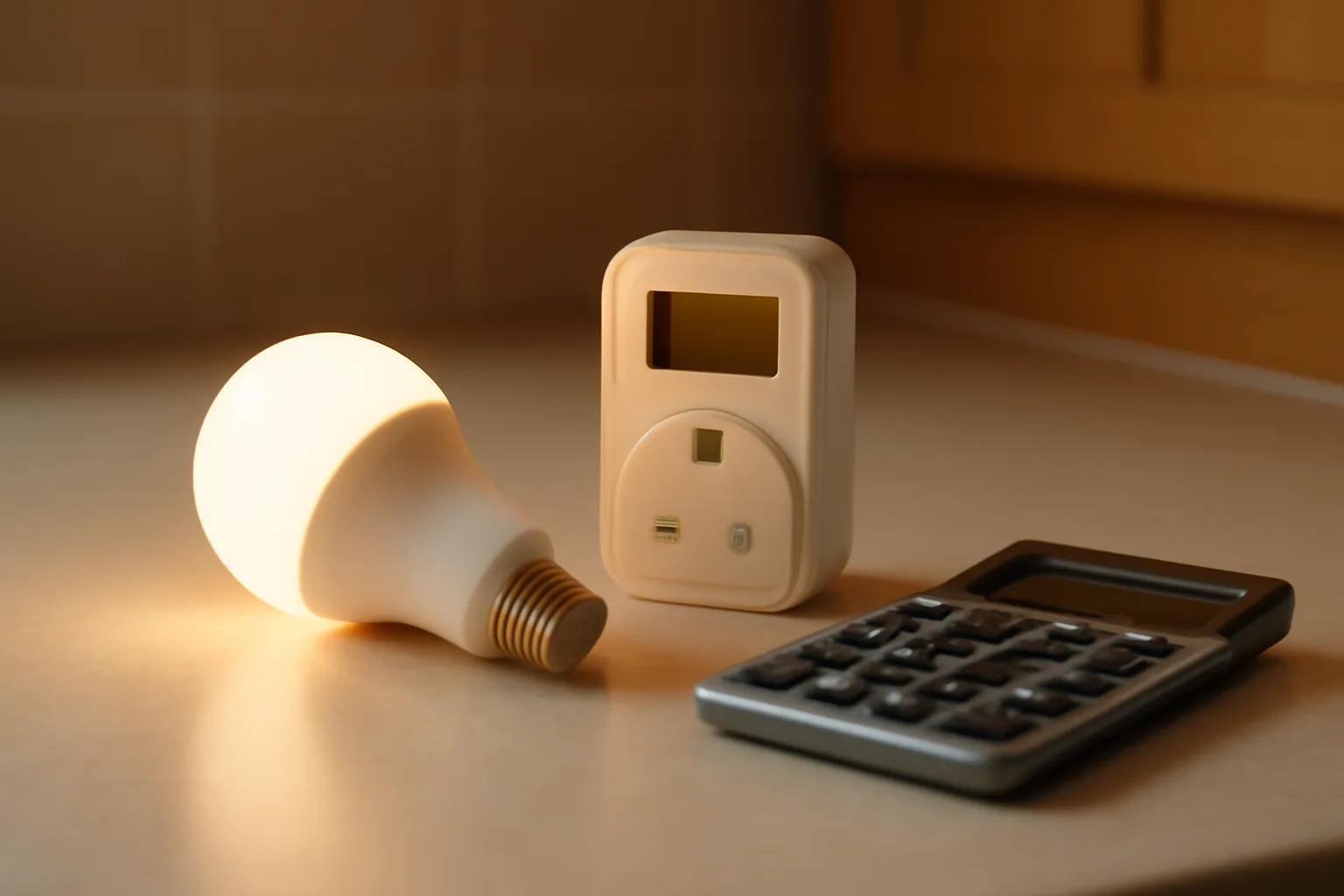
The maths is simple once you know the bulb wattage and your electricity price.
- Find the wattage: check the bulb, packaging or product page. A normal smart bulb is often 7-9W. Brighter bulbs can be 10-13W. Light strips can be much higher.
- Convert watts to kilowatts: divide by 1,000. An 8.1W bulb is 0.0081kW.
- Multiply by hours used: 0.0081kW x 5 hours = 0.0405kWh per day.
- Multiply by your unit rate: 0.0405kWh x 26.11p = about 1.06p per day.
- Multiply by 365: 1.06p x 365 = about £3.86 per year.
That example uses a Philips Hue 1100-lumen E27 colour bulb, which Philips Hue lists at 8.1W and £54.99 in the UK. The running cost is low. The purchase price is not.
If you want a quick rule of thumb, use this:
- 5W smart candle bulb: about 0.13p per hour
- 8W standard smart bulb: about 0.21p per hour
- 10W bright smart bulb: about 0.26p per hour
- 20W light strip setup: about 0.52p per hour
Run the numbers across a normal UK lighting setup and the pattern is boring in a useful way: bulbs barely move the meter, but old halogen downlights do. If you are replacing 35-50W halogens with 5-6W smart GU10s, the running-cost saving can be real. If you are replacing existing LEDs with smart LEDs, it is mostly a control upgrade.
What Different Smart Bulbs Cost to Run
Smart bulbs are not all the same, but the running-cost differences between standard models are small. A 6W bulb and a 9W bulb used for five hours a day differ by about £1.43 per year at 26.11p per kWh.
The bigger differences are brightness, colour quality, app reliability, hub choice and the upfront price.
Budget smart bulbs
IKEA’s smart range is the obvious budget reference in the UK. Its KAJPLATS and TRADFRI bulbs are often around £5-£9 depending on fitting, lumen output and colour temperature. They are not as polished as Hue, and the app ecosystem is less slick, but the basic cost case is strong.
A £8 IKEA smart bulb that uses around 7-9W will cost about £3.30-£4.30 per year if used for five hours a day. For utility rooms, children’s lamps, hallway bulbs and spare bedrooms, that is where I would start.
Mid-range Wi-Fi bulbs
TP-Link Tapo and WiZ sit in the sensible middle. A Tapo L530E colour bulb is commonly about £11.99-£13.99 in the UK, with an 8.7W rating. WiZ colour bulbs often sit around £11-£25 depending on fitting and brightness.
At 8.7W for five hours a day, the active running cost is about £4.15 per year. Standby might add another £1 or so. The practical trade-off is that Wi-Fi bulbs do not need a separate hub, but a house full of them can make your router and app list feel messy. For three or four bulbs, fine. For twenty, I would rather use a hub-based setup.
Premium smart lighting
Philips Hue is still the premium choice because the app, accessories, switches, motion sensors and scene control are better than the cheap options. The cost is the issue. A Hue White Ambiance E27 bulb can be about £34.99; a Hue White and Colour Ambiance E27 1100-lumen bulb is currently listed at £54.99.
That Hue colour bulb still only costs about £3.86 per year for five hours of daily use. You buy Hue because you want reliable control, smooth dimming, room scenes, sensor routines and long-term ecosystem support. You do not buy it because the running cost is lower than a Tapo bulb. It usually is not.
Smart light strips and decorative lighting
Light strips are where the running cost starts to matter a little more. A 5m strip might draw 18-24W at high brightness. Used behind a TV for four hours every night, that could cost about £6.90-£9.15 per year. Still not frightening, but higher than a single bulb.
The sneaky cost is buying extensions, controllers, diffusers and extra strips. A cheap strip can start at £20-£30; a better Hue or Nanoleaf setup can run past £80-£150 very quickly.
If you are planning a whole-room lighting scheme, read our guide to Zigbee vs Z-Wave vs Wi-Fi smart lighting protocols before buying ten random bulbs that all need separate apps.
Do Smart Lights Use Power When They Are Off?
Yes. A smart light needs a tiny standby draw so it can remain connected. If you turn it off at the wall, it cannot receive a command from Alexa, Google Home, Apple Home, the manufacturer’s app or a motion sensor.
This standby use annoys people because it feels wasteful. Fair enough. But in the real numbers, it is small.
A 0.3W standby draw over 24 hours is:
- 0.0072kWh per day
- 2.63kWh per year
- about 69p per year at 26.11p per kWh
Even twenty bulbs at 0.3W standby would be about £13.80 per year. That is not nothing, but it is less than one takeaway pizza. The bigger problem is usually behavioural: if smart lighting makes it easy to create bright decorative scenes and leave them running every evening, your active use can rise.
We saw this with a living-room setup using two lamps, a TV light strip and a shelf light. The individual devices were efficient, but the room went from one lamp in the evening to four lights because the scene looked good. The bill increase was still modest, but the “smart lights save money” claim stopped being true.
There is one rule I would stick to: do not cut power to smart bulbs at the wall every day unless you are happy with automations breaking. If you want wall control, use smart switches, remotes or button accessories that keep the bulb powered.
For related setup choices, our guide to setting up smart lights at home covers room grouping, app control and switch behaviour in more detail.
When Smart Lighting Saves Money
Smart lighting saves money when it changes behaviour. The bulb efficiency matters, but automation is the useful bit.
Replacing halogen bulbs
This is the cleanest win. A 50W halogen GU10 used five hours daily costs about £23.82 per year at 26.11p per kWh. A 5.7W smart GU10 used the same way costs about £2.72 per year, plus a small standby amount.
If you have eight halogen kitchen downlights, replacing them with LED smart bulbs or smart-compatible LED fittings can save real money. The payback depends on bulb price:
- Cheap LED GU10 bulbs: fastest payback, often under a year if replacing halogen
- Smart GU10 bulbs at £10-£20 each: slower payback, but still defensible in high-use rooms
- Hue GU10 bulbs at premium prices: buy for control and colour, not pure payback
If you already have LED GU10s, the saving is much smaller. Replacing a working 5W LED with a 5.7W smart LED may raise the running cost slightly.
Schedules that stop lights being left on
Schedules are boring, but they work. Hallway lamps, landing lights, children’s room lamps and garden lights are the usual offenders.
A single 8W bulb accidentally left on for eight extra hours every night costs about £6.10 per year. That is not life-changing, but across several rooms it adds up. More to the point, schedules remove the argument. Lights go off at 11pm. Done.
This is where the article on smart lighting scenes and schedules is useful. Scenes are for comfort; schedules are where the saving usually happens.
Motion sensors in low-use spaces
Motion sensors make most sense in hallways, utility rooms, downstairs loos, garages and cupboards. They are less useful in living rooms, where people sit still long enough to be plunged into darkness at exactly the wrong moment.
A decent motion sensor might cost £15-£40 depending on brand. Pair that with a cheap smart bulb and the payback is slow if you only care about energy. Pair it with several lights in a busy hallway, and the convenience starts to justify it.
After using a Hue motion sensor on a landing, I would buy one again for convenience before savings. The lights come on dim at night, brighter in the evening, and off after a minute. It feels civilised, and it stops the landing light being left on until breakfast.
Dimming and adaptive brightness
LEDs use less power when dimmed, though not always in a perfectly linear way. A bulb at 50% brightness usually uses less than full power, and most people do not need full output in the evening.
This is one of the quiet benefits of smart bulbs. Instead of using a 100% lamp all evening, you might run it at 35-50%. The saving per bulb is small, but the comfort improvement is real.
If you are choosing between brands for scenes and dimming quality, compare our Philips Hue vs LIFX vs Nanoleaf guide before spending premium money.
When Smart Lights Are Not Worth It for Energy Savings
Smart lights are weak as an energy-saving upgrade if your home already uses LED bulbs and you are happy turning lights off manually.
Here is the blunt version: swapping a normal 8W LED for an 8.7W smart bulb saves no electricity. It may use slightly more because of standby. You might still love it, but that is a convenience purchase.
The payback case is weakest in:
- Rooms used briefly: spare bedrooms, loft spaces and cupboards where lights are barely on
- Already-efficient fittings: modern LED downlights with low wattage
- Single-bulb rooms: the purchase price dominates the running cost
- Decorative colour setups: they often increase lighting use because they look good
- Homes with unreliable Wi-Fi: cheap Wi-Fi bulbs can become more irritating than useful
There is also a replacement-cost problem. A £54.99 smart bulb that saves 50p a year compared with another LED is not an energy investment. It is a lifestyle and control upgrade.
I am not anti-Hue. In fact, Hue is the setup I would choose for a main living space if the budget allowed it. But I would not pretend it pays for itself on the electricity bill. The value is reliability, switches, sensors, dimming quality and the fact that the system still feels supported years later.
For a cheaper whole-home approach, smart plugs can sometimes do more useful work than bulbs. Lamps, fans, chargers and Christmas lights are often better plug candidates than ceiling bulbs. Our smart plugs guide covers the cases where a plug beats replacing the bulb.
My Practical UK Setup Advice
Start with rooms where lighting behaviour is annoying, not rooms where you hope to shave pennies off the bill.
For most UK homes, I would split it like this:
Living room
Use better bulbs here because you notice dimming, colour temperature and scene quality. Two or three Hue White Ambiance bulbs at about £34.99 each make more sense than cheap colour bulbs if you mainly want warm evening light and brighter task light.
If you want colour for film nights, buy one colour feature light rather than colour bulbs in every socket. A single light strip or lamp gives the effect without turning the room into a showroom.
Kitchen and hallway
If you have old halogens, replace them. If you already have efficient LEDs, think carefully before going fully smart. Kitchen downlights can be expensive to convert because there are often six to ten of them.
For hallways, I like a motion sensor plus cheap white smart bulbs. You do not need millions of colours to walk to the loo at midnight. IKEA, Tapo or basic Hue White bulbs are enough.
Bedrooms
Smart bulbs are good in bedrooms if you use wake-up routines, dim evening light or voice control. They are not magic for sleep, but warm dim light is nicer than blasting a ceiling bulb at 10.30pm.
I would use one or two bedside lamps rather than the main ceiling pendant. It gives better control and costs less to set up.
Garden and outdoor lighting
Outdoor smart lighting can be brilliant, but watch the wattage and runtime. Garden scenes left on until 1am every night cost more than indoor bulbs because there are often more fittings and higher-output strips.
Use schedules. Set them to sunset plus a fixed off time. Do not rely on remembering.
The buying order I would use
- Replace any halogen bulbs with LEDs first. This gives the real energy saving.
- Add smart control to the rooms you use daily. Living room, hallway and main bedroom first.
- Use budget bulbs where colour quality does not matter. Utility, landing, spare room, kids’ lamps.
- Spend on sensors and switches before buying colour everywhere. Control matters more than rainbow scenes.
- Only go premium where reliability matters. Main rooms justify Hue; a cupboard probably does not.
The bottom line: the smart lights running cost is low enough that it should not put you off. But do not buy smart lighting as a pure money-saving move unless you are replacing halogen bulbs or solving a specific “lights left on” problem.
Frequently Asked Questions
How much does one smart bulb cost to run per year? A normal 8-9W smart bulb used for five hours a day costs about £3.80-£4.30 per year at 26.11p per kWh, plus roughly 50p-£1.15 in standby use.
Do smart lights cost more to run than normal LED bulbs? Usually a little, because they use standby power while switched off. The difference is small, often under £1 per bulb per year. The purchase price matters much more.
Is Philips Hue expensive to run? No. Philips Hue is expensive to buy, not expensive to power. A Hue 8.1W colour bulb used five hours daily costs about £3.86 per year for active use at the current Ofgem average unit rate.
Should I turn smart bulbs off at the wall? Not for everyday use. Turning them off at the wall saves standby power but breaks app, voice, schedule and sensor control. Use smart switches, remotes or routines instead.
Can smart lighting reduce my electricity bill? It can if it replaces halogen bulbs, stops lights being left on, or uses motion sensors and schedules well. If you already use LED bulbs and manually turn them off, savings will be small.
Are smart light strips expensive to run? A 20W light strip used for four hours a night costs about £7.60 per year at 26.11p per kWh. The real cost is usually the kit price, extensions and extra controllers.